01 / MARKETPLACE MODERNIZATION
Modernizing a live marketplace
TCGplayer’s customer-facing marketplace was a large, monolithic application built primarily for desktop use. Many pages still relied on rigid, table-based layouts that were difficult to adapt to smaller screens.
The company had explored full redesigns with outside agencies, but putting those concepts into production remained a challenge. A complete redesign would have required coordinating changes across a large number of pages, systems, and teams while keeping the marketplace running.
We had ideas for where the product should go. What we needed was a manageable way to get there.
02 / RESPONSIVE STRATEGY
A more practical approach to responsive design
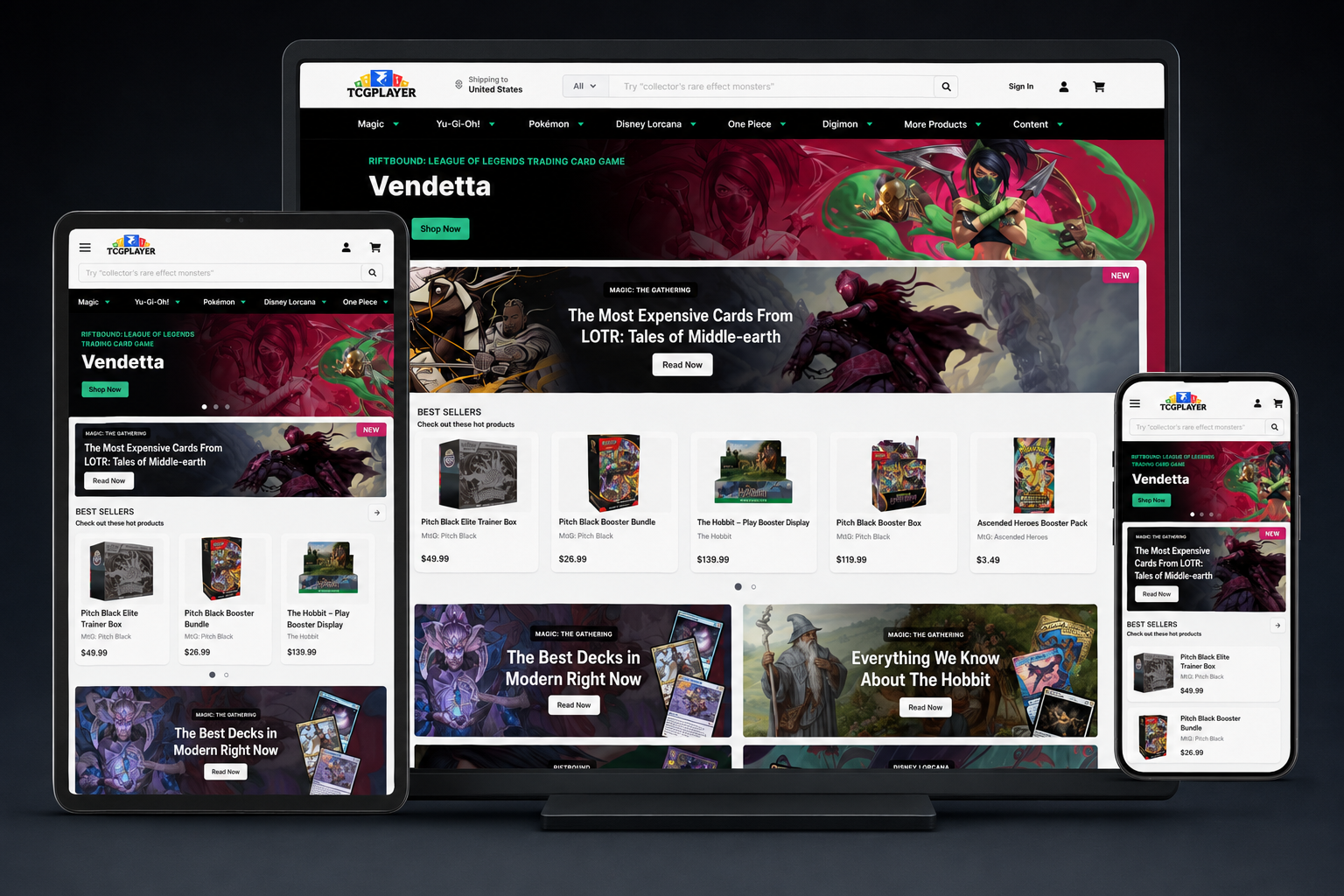
During a one-week internal hackathon, I explored whether we could separate mobile support from the larger visual redesign.
Rather than redesigning every page before development could begin, I kept the existing appearance largely intact and rebuilt the underlying layouts to be responsive. This gave us a simpler path:
- Make the existing marketplace usable across screen sizes
- Improve individual pages and features over time
- Avoid tying mobile support to one large redesign and launch
By the end of the week, I had created a working prototype covering roughly 90% of the customer-facing page types.
The prototype gave the team a concrete alternative to rebuilding everything at once. TCGplayer could create a responsive foundation first, then modernize the visual experience in smaller, more manageable pieces.
03 / INFORMATION DESIGN
Adapting dense marketplace information
Making the marketplace responsive involved more than shrinking a desktop page.
Product names, card conditions, sellers, prices, quantities, filters, and purchasing controls all competed for space. On smaller screens, I needed to decide what customers should see immediately, what could move elsewhere, and how purchasing interactions could change without becoming unfamiliar.
Those decisions also had to work across many different page types. The prototype needed to demonstrate a reusable approach rather than solve only a few carefully selected screens.
The result was a realistic modernization strategy for the existing marketplace—one that improved mobile usability while leaving room for the visual design to evolve separately.
04 / IN-STORE COMMERCE
An in-store catalog for local game stores
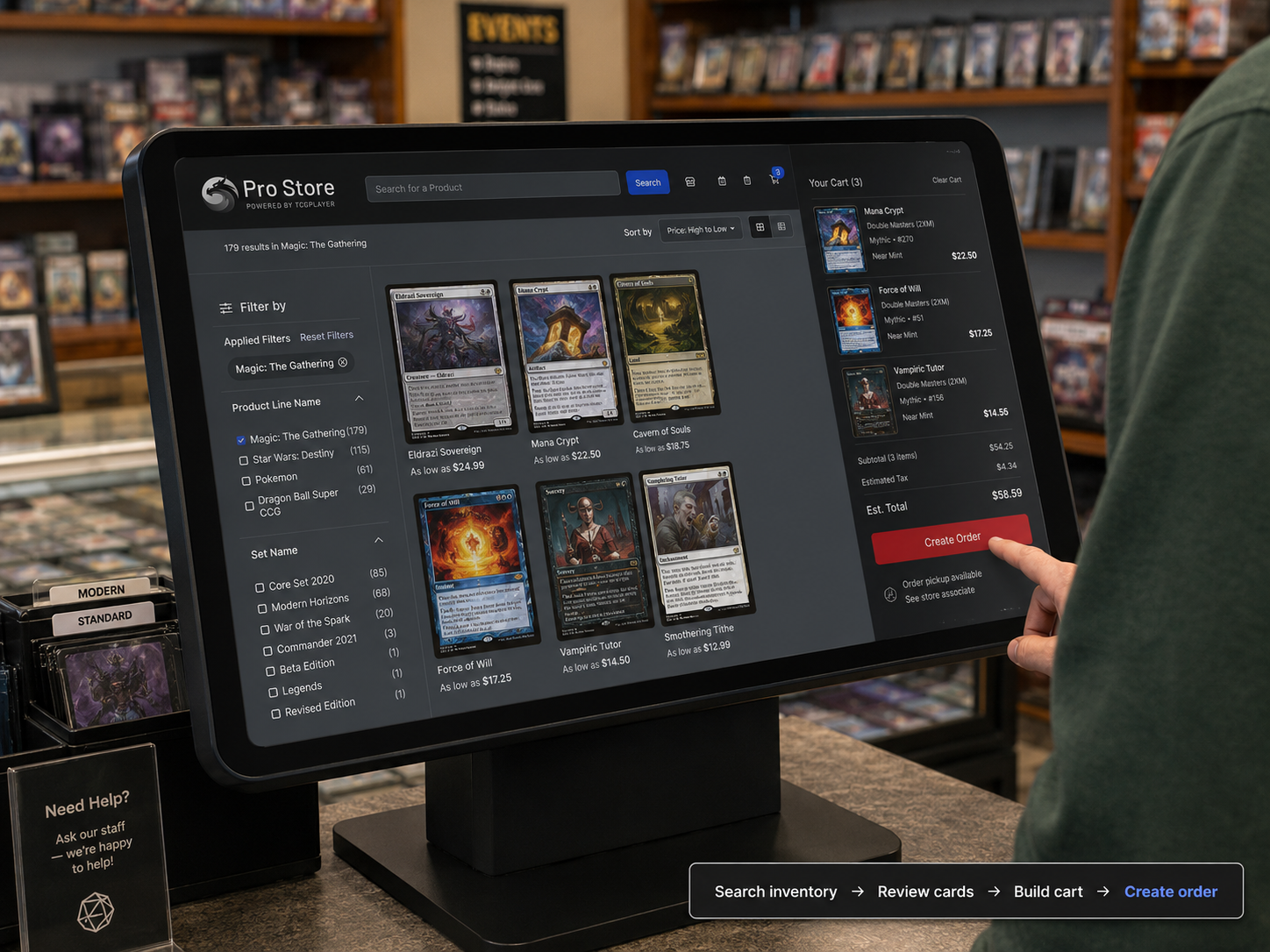
Another major project I worked on at TCGplayer was an in-store catalog and ordering kiosk for local game stores.
Stores could have far more cards in stock than they could reasonably display. Customers often browsed display cases or dense binders, then asked an employee whether particular cards were available.
The kiosk gave customers a way to search the store’s broader inventory themselves. They could:
- Search and browse available cards
- Review product details and pricing
- Add items to a cart
- Create an order for the store to fulfill
It brought the convenience of the store’s online catalog into the physical shopping experience. Customers could browse at their own pace, and employees no longer needed to guide every inventory search personally.
05 / KIOSK WORKFLOW
Designing around the in-store workflow
I worked on the kiosk from the initial wireframes and customer flows through product stories, interface design, and frontend development.
The experience needed to make sense without training. Search, availability, product details, cart management, and order creation all had to be clear to someone walking up to the kiosk for the first time.
It also needed to fit into tools retailers already used. I worked with the API team on the inventory and ordering services, then connected the kiosk’s configuration to the existing retailer account portal.
The final experience was designed specifically for someone shopping inside the store, with fewer distractions and a clearer path from searching the catalog to submitting an order.
06 / RETAILER PLATFORM
Launching storefronts for more than 600 retailers
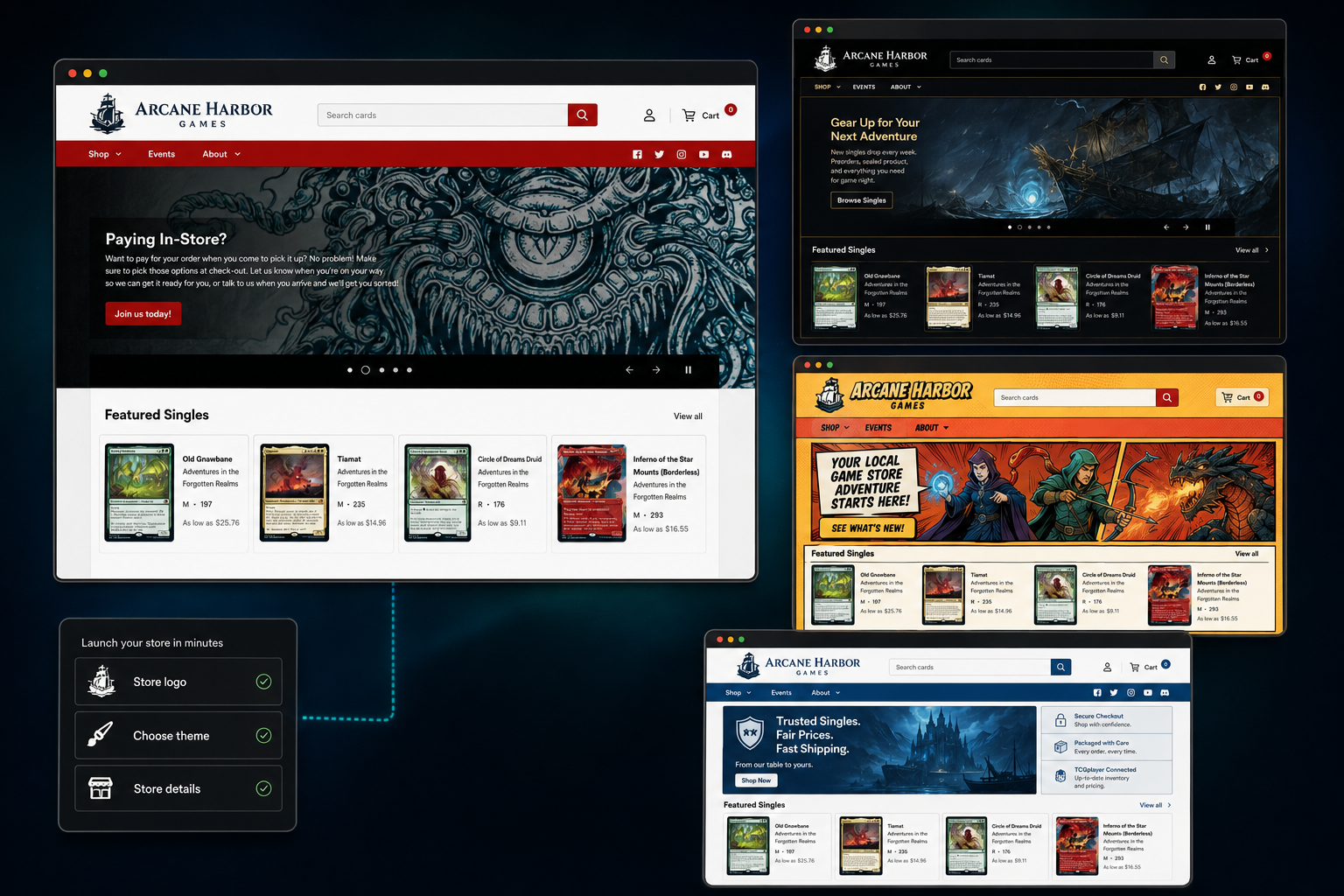
Another major project was creating a hosted storefront platform for TCGplayer retailers.
Most participating stores already maintained their inventory in TCGplayer. The opportunity was to turn that existing data into a complete customer-facing website without asking each retailer to build or populate one themselves.
I created a system of more than 20 storefront templates that stores could choose from. Launching a site required little more than uploading logos and replacing a few pieces of placeholder content. Banner artwork was provided, while product inventory, card details, and card imagery were populated from TCGplayer through its APIs.
The challenge was providing enough variety for each store to have a distinct presence while keeping hundreds of sites practical to launch and maintain. The templates shared a reusable foundation but offered different layouts and visual treatments, all built to work with the same retailer data.
The platform ultimately supported more than 600 retailer websites hosted through Umbraco Cloud. It gave stores a usable ecommerce presence with very little setup while allowing TCGplayer to operate the entire network through a shared system.
07 / OUTCOME
Outcome
My work at TCGplayer covered three different parts of the customer and retailer experience.
The responsive prototype demonstrated a practical way to bring a large desktop-only marketplace to mobile, covering roughly 90% of its customer-facing page types during a one-week hackathon. The in-store kiosk gave shoppers direct access to inventory that had previously been difficult to browse inside local game stores. The hosted storefront platform turned inventory already managed through TCGplayer into complete retailer websites and was rolled out to more than 600 stores.
Each project addressed a different problem, but the approach was similar: understand what TCGplayer and its retailers already had, then find a practical way to make it substantially more useful without requiring everything around it to be rebuilt.